An old year is coming to the finish line, a new year is waiting to come out of the gate. So let’s take a look at ten possibilities and predictions for 2026. 2025 has been quite a year. The AI explosion is affecting all of us. Technical communication is currently undergoing its most significant transformation since the move from print to online help. By late 2026, the field will have pivoted from “writing for people” to “creating information for AI agents and people.”
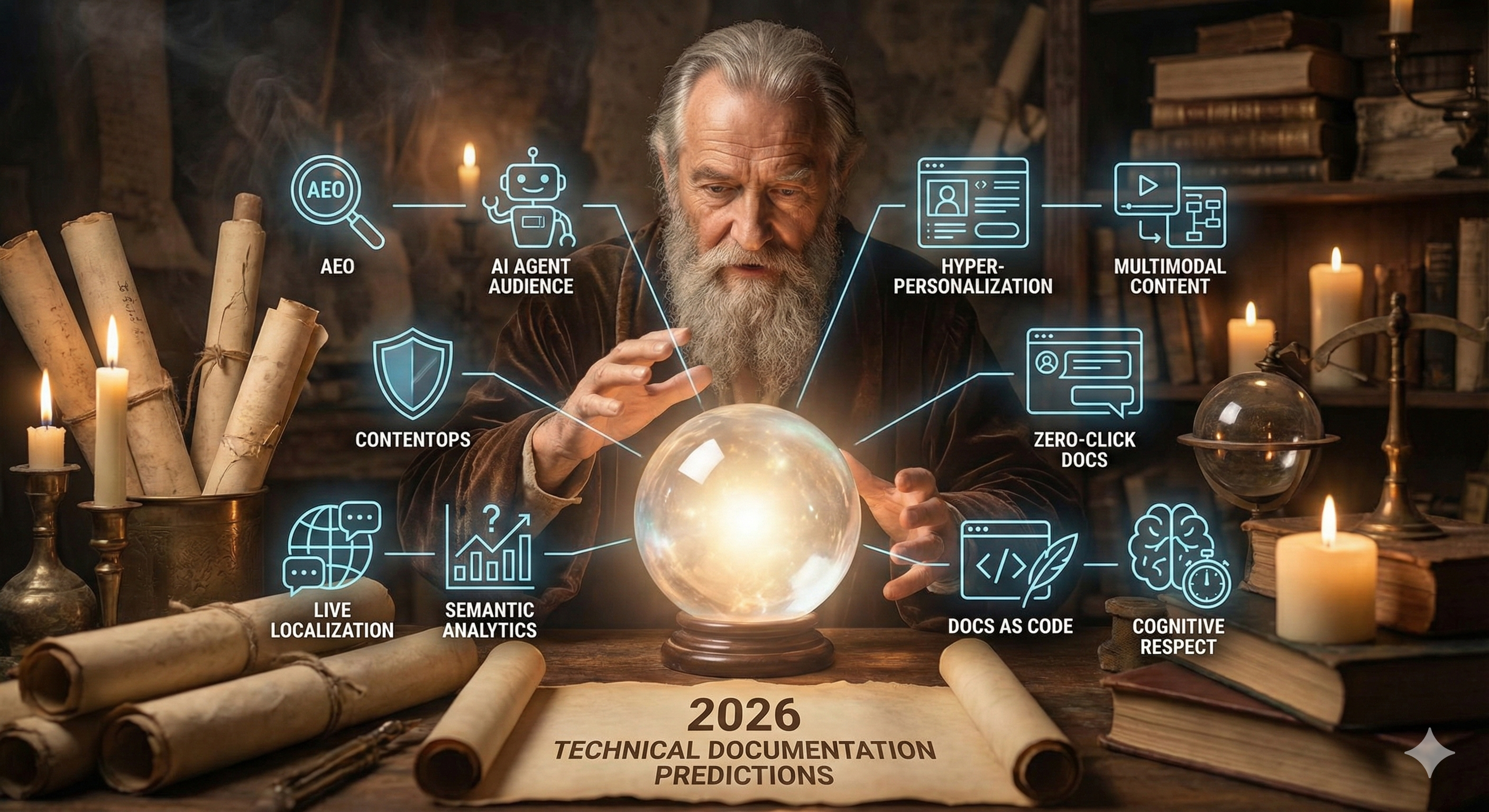
Here are ten things in technical communication that may (will?) change in 2026. Many have already started happening.
1. The Shift from SEO to AEO (Answer Engine Optimization)
In 2026, optimizing for Google’s “ten blue links” is secondary. The primary goal is Answer Engine Optimization (AEO).
- The Change: Users (and AI bots) no longer browse search results; they increasingly ask questions to engines like ChatGPT, Perplexity, or Google’s AI Overviews.
- The Impact: Technical writers must learn to structure content so it can be “cited” by these engines. This means answering questions directly in the first 100 words of a topic, using precise “Q&A” headers, and implementing rigorous schema markup so AI can extract the answer without hallucinating.
2. The “Agentic” Audience
Your newest and most frequent reader in 2026 won’t be a human; it will be an AI Agent.
- The Change: Autonomous AI agents will read your documentation to learn how to execute tasks on behalf of users (e.g., “Go configure the API to accept payments”).
- The Impact: Documentation must become machine-readable and logically flawless. Ambiguity in instructions (“select the appropriate option”) will cause agents to fail. Will we see a rise in “Instruction sets for Agents” hidden within public documentation?
3. Hyper-Personalization (The Death of the Static Manual)
The concept of a single “User Guide” for everyone will effectively vanish for enterprise software.
- The Change: Documentation portals will dynamically assemble content based on the logged-in user’s role, subscription tier, and past behavior.
- The Impact: Instead of searching for “How to export data,” a user will see a custom guide generated on the fly that only shows the export methods available to their specific permission level, filtering out irrelevant noise automatically.
4. Multimodal Content Generation
Text-to-Video and Text-to-Diagram will become standard, friction-free workflows.
- The Change: Writers will no longer need complex tools to create explainer videos. Generative AI will convert a written procedure into a 30-second video tutorial or a schematic diagram.
- The Impact: “Wall of text” documentation will be unacceptable. Every complex procedure will be expected to have an accompanying micro-video or interactive visual, generated and updated automatically alongside the text.
5. ContentOps as “Truth Management”
The role of the technical writer will shift from “Content Creator” to a sort of “Truth Manager.”
- The Change: Since AI can draft some of the content, the human value shifts to verification. Writers will spend their time managing the Source of Truth — ensuring the structured data, facts, and logic fed into the AI are 100% accurate.
- The Impact: “Governance” becomes a daily task. Writers will guard against “AI rot” (where AI models rely on outdated specs) by strictly managing version control and metadata.
6. Zero-Click Documentation (In-App Integration)
Users will stop visiting documentation portals entirely for day-to-day tasks.
- The Change: Documentation will be ingested by the product’s embedded AI assistant, such as Intercom’s FIN AI. Users will ask the product, “How do I map Shopify Payment Fields to PayPal?” and the product will answer in a chat window using your documentation.
- The Impact: Metrics like “Page Views” will fall and become irrelevant. The new success metric will be “Answer Confidence” or “Task Completion Rate” via the in-app assistant.
7. Real-Time “Live” Localization
The traditional “freeze content -> send to translation vendor -> wait 2 weeks” workflow will collapse.
- The Change: Neural Machine Translation (NMT) combined with LLMs will allow for near-instant publishing in dozens of languages with high accuracy.
- The Impact: Localization becomes part of a continuous delivery pipeline. Human review will move to a “spot-check” or “post-editing” model rather than complete manual translation, drastically reducing the cost and time-to-market for global docs.
8. Semantic Analytics
We will stop tracking what pages people visit and start tracking what questions content failed to answer.
- The Change: Analytics tools will analyze the semantic intent of user queries. You will get reports saying, “500 users asked about ‘API Rate Limits’ but your content only covers ‘API Authentication’.”
- The Impact: Content strategy will be driven by “Missing Answers” reports rather than “Most Viewed” lists.
9. The Rise of “Docs as Code” for Non-Developers
The tools developers use (Git, Markdown, CI/CD pipelines) will be wrapped in user-friendly interfaces for all writers. This has been happening, but will accelerate in 2026.
- The Change: The efficiency of “Docs as Code” (version control, automated testing of links/code) is too valuable to ignore, but the learning curve has been too high.
- The Impact: New CMS tools will hide Git’s complexity while preserving its benefits. Writers will “commit” changes that trigger automated tests (checking for broken links, style guide violations, and terminology errors) before a human ever reviews them.
10. Cognitive Respect and Minimalism
As AI generates infinite content, human attention becomes the scarcest resource.
- The Change: There will be a backlash against “fluff” or over-explained content.
- The Impact: Documentation will become ruthlessly minimalist. If an AI can explain the “concept,” the official docs may only list the “reference” and “critical warnings.” The trend will be Cognitive Respect: respecting the user’s intelligence and time by providing only the information necessary.
Welcome to the New Year
The road to 2026 looks like an exciting journey for us all. While we are shifting from just writing for people to creating information for AI agents, this is a huge opportunity to increase the value of what we do and remain relevant. Embrace change to ensure your documentation stays vital and valuable. At the end of the day, our goal hasn’t changed: it’s still about showing our users respect and giving them precisely the help they need, right when they need it.