Artificial intelligence and deep learning are often used interchangeably, but they describe very different things. Understanding the distinction helps clarify what modern technology can actually do and where its limitations lie.
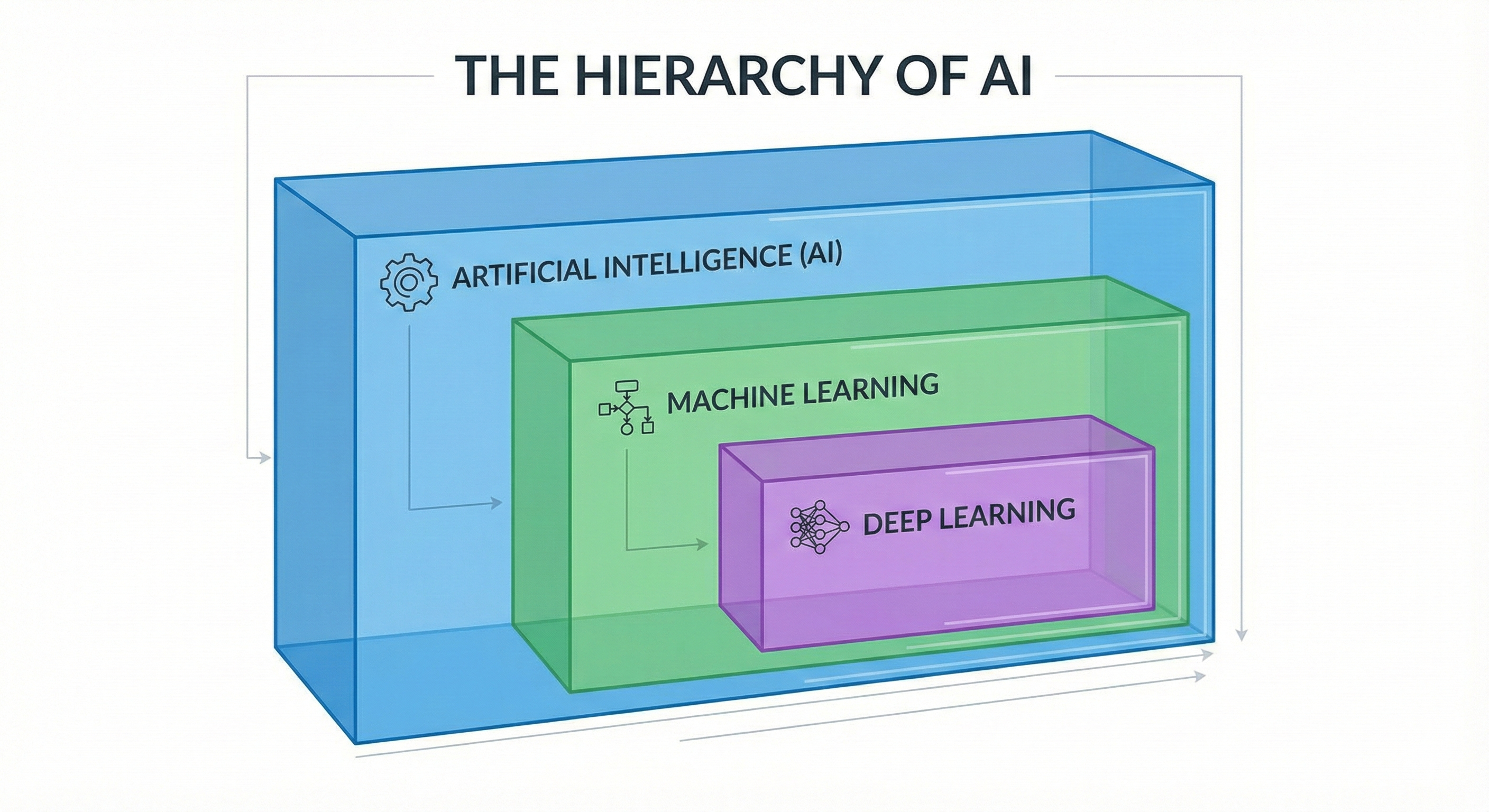
Artificial intelligence is the broad discipline focused on creating machines that can perform tasks requiring human-like intelligence. The field dates back to the 1950s, when researchers first began exploring whether computers could be programmed to think, reason, and solve problems. AI encompasses everything from simple rule-based systems to sophisticated learning algorithms. When your email client filters spam into a junk folder or your GPS calculates the fastest route home, you’re interacting with AI systems.
Early AI relied heavily on explicit programming. Engineers would define rules and logic trees that specified exactly how the system should behave in every situation. A chess program from the 1980s, for example, might contain thousands of hand-coded rules about which moves to consider and how to evaluate board positions. These systems could be remarkably effective within narrow domains, but they struggled when encountering situations their programmers hadn’t anticipated. They also required enormous effort to build and maintain, since every rule had to be written by hand.
Machine learning emerged as a different approach. Rather than programming explicit rules, engineers feed data to algorithms that learn patterns on their own. A spam filter built with machine learning doesn’t need someone to define what spam looks like. Instead, it analyzes thousands of emails labeled as spam or not spam and learns to recognize the distinguishing characteristics. This makes machine learning systems more adaptable and often more accurate than rule-based approaches, particularly for problems where the underlying patterns are difficult for humans to articulate.
Deep learning takes machine learning further by using artificial neural networks with many layers of processing. These networks are loosely inspired by how biological neurons connect in the brain. Each layer transforms the data in some way, extracting increasingly abstract features. In an image recognition system, early layers might detect edges and simple shapes, middle layers might identify textures and patterns, and later layers might recognize objects like faces or cars. The “deep” in deep learning refers to these multiple layers working together.
Consider how each approach might handle the task of identifying whether a photograph contains a cat. A traditional AI system would require programmers to define what constitutes a cat: pointed ears, whiskers, fur patterns, body proportions. This proves nearly impossible to specify completely, since cats appear in endless poses, lighting conditions, and partial views. A machine learning system might use manually designed features like color histograms or edge detection, then learn which combinations indicate cats. Deep learning bypasses manual feature design entirely. Given enough labeled photographs, a deep neural network learns to identify cats by discovering relevant features on its own, often finding patterns humans wouldn’t think to specify.
This capability explains why deep learning has driven recent AI breakthroughs. Large language models that can write essays and hold conversations, systems that generate realistic images from text descriptions, and software that transcribes speech with near-human accuracy all rely on deep learning. These applications involve patterns too complex and numerous for humans to define manually.
Deep learning does have significant requirements. Training these models demands massive datasets, sometimes millions or billions of examples. The computational resources needed can be substantial, often requiring specialized hardware running for days or weeks. The resulting models can also be challenging to interpret. When a deep learning system makes a decision, explaining exactly why it reached that conclusion is often impossible. For applications where transparency matters, such as medical diagnosis or loan approvals, this opacity creates challenges.
Traditional AI approaches remain valuable when data is scarce, when decisions must be explainable, or when the problem domain is well understood. Expert systems in specialized fields, business rule engines, and many robotics applications still rely on explicitly programmed logic rather than learned patterns.
The relationship between these concepts is hierarchical. AI is the broadest category, encompassing any system designed to exhibit intelligent behavior. Machine learning is a subset of AI focused on systems that learn from data. Deep learning is a subset of machine learning using multi-layered neural networks. Not all AI uses machine learning, and not all machine learning uses deep learning, but the most capable AI systems today typically do.